Conviction of student's killer sparks Southampton protests and questions over police response
The murder of 18-year-old Henry Nowak has reignited a charged debate over policing after body-worn footage showed officers handcuffing the dying teenager.
Eleanor Whitfield
Writer ·
The conviction of a man for the murder of teenage university student Henry Nowak has triggered angry demonstrations in Southampton and a fresh national argument about how police treat victims at the scene of violent crime. What began as grief for a young life cut short has rapidly broadened into a wider confrontation over trust in policing, the conduct of officers in the crucial moments after a stabbing, and the way emotive cases are amplified online.
Vikrum Digwa was found guilty of murder and jailed for life after stabbing the 18-year-old five times during an altercation. The court rejected Digwa's claim that he had been racially abused before the attack, a defence prosecutors said was without foundation. The jury's verdict, delivered after several hours of deliberation, brought a measure of legal closure for the Nowak family but did little to quiet the public anger that the case has generated.
For the city of Southampton, the trial has become a flashpoint. Tributes left near the scene have grown into makeshift memorials, and what should have been a moment of justice has instead exposed deep unease about whether the teenager could have been treated differently in his final minutes.
Footage that prompted national alarm
Much of the public anger has centred on body-worn video showing officers placing handcuffs on the fatally wounded teenager as he repeatedly told them he had been stabbed and could not breathe. According to his father, Henry said he could not breathe nine times before he died. The footage, replayed widely on social media, has become the emotional core of the controversy, with many viewers questioning why a critically injured young man was restrained rather than urgently treated.
“With his final words, he told them that he could not breathe. He told them he had been stabbed.”
— Henry Nowak's father
Policing experts have urged caution in interpreting the footage in isolation, noting that officers arriving at a chaotic and potentially dangerous scene must rapidly assess threats before they can render aid. Yet that explanation has done little to reassure a public primed to see the images as evidence of indifference. The episode has prompted calls for an independent review of how first responders are trained to balance scene safety with immediate medical care.
Several campaign groups and the family's representatives have indicated they want answers about decision-making in the critical window between officers arriving and paramedics taking over. Questions raised include how quickly the severity of Henry's injuries was recognised, whether first aid was administered, and what guidance officers follow when a suspect and a victim are present at the same scene.
Demonstrations turn tense
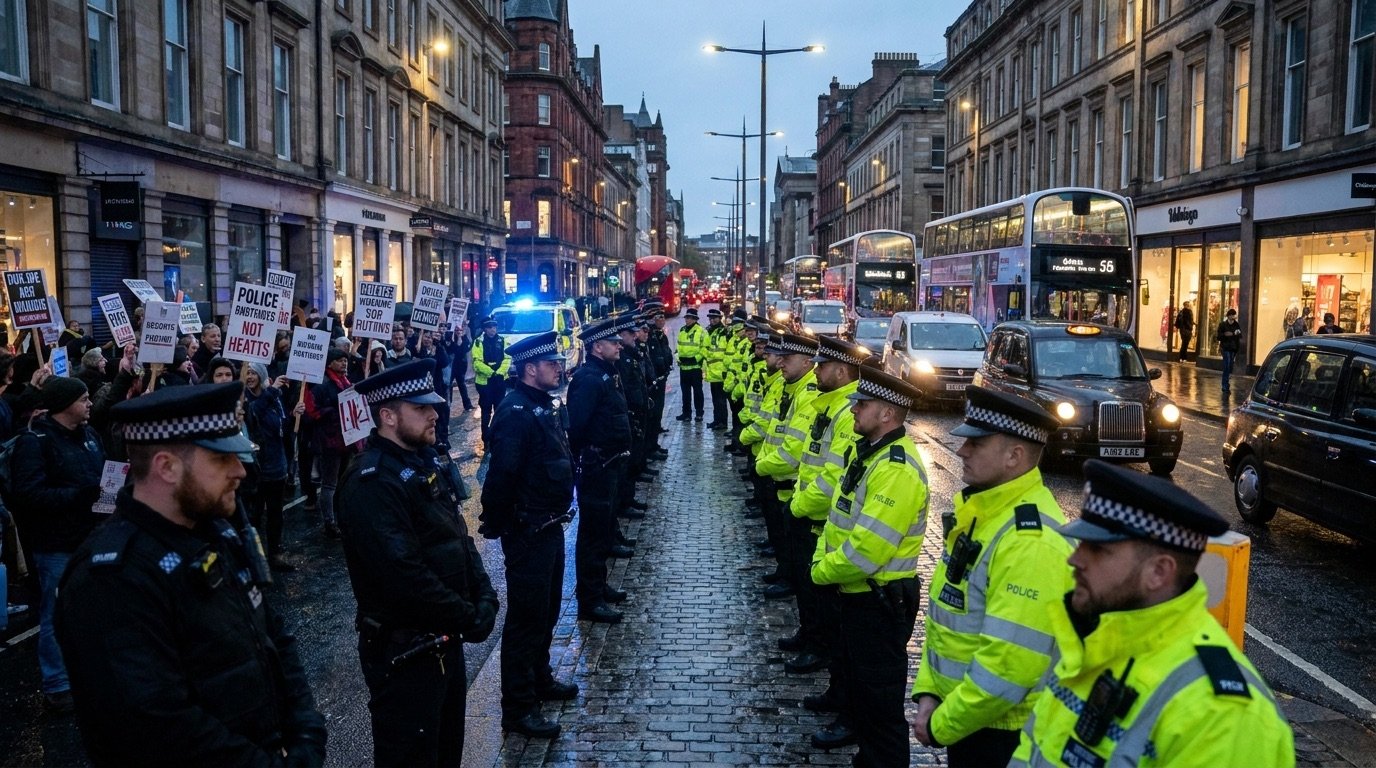
Hundreds of people gathered near the scene on 2 June, some throwing rocks and flares. What organisers described as a peaceful vigil drew a larger and more volatile crowd, and police in protective equipment formed lines to keep groups apart. The demonstrations have continued on subsequent evenings, with a heavy uniformed presence deployed across the city centre.
Local authorities have appealed for calm, warning that disorder risks overshadowing the family's grief and inflaming community tensions. Among the concerns voiced by officials is that the case has been seized upon by groups with broader political agendas, some of whom have sought to link the killing to debates over immigration and identity that have little bearing on the facts established in court.
- Body-worn footage shows officers handcuffing the dying teenager at the scene
- Hundreds gathered near the scene on 2 June, with some throwing rocks and flares
- Police formed lines to separate rival groups as demonstrations turned tense
- Officials warned against exploiting the case to stoke division
- Calls have grown for an independent review of the police response
Background: a recurring debate over trust
The Nowak case lands at a moment when public confidence in policing has already been under strain. A series of high-profile scandals and inquiries in recent years has left some communities sceptical of official accounts, and the speed at which raw footage now circulates online means that individual incidents can crystallise wider grievances within hours. The phrase 'two-tier policing', used by some commentators to allege inconsistent treatment of different groups, has featured prominently in the online reaction, though senior figures have firmly rejected the characterisation.
Forces across England and Wales have invested heavily in body-worn cameras precisely to improve transparency and accountability. In this instance, that same technology has fuelled public scrutiny rather than allayed it, illustrating how footage can cut both ways depending on what it appears to show.
Political response
Prime Minister Sir Keir Starmer described the footage as harrowing, while Home Secretary Shabana Mahmood urged against using the tragedy to divide communities, rejecting claims of so-called two-tier policing seized upon by some political figures. Ministers have signalled that they expect the relevant oversight bodies to examine the police response thoroughly and transparently.
“This tragedy must not be used to set communities against one another.”
— A Home Office spokesperson
Opposition figures and campaigners have pressed for clarity on whether any officers will face disciplinary scrutiny and how lessons will be applied nationally. The handling of the case is likely to feed into the continuing political contest over law and order, an area where all the main parties are seeking to project authority.
What happens next
With Digwa now sentenced, attention turns to the conduct of the police response, which is expected to be examined by the relevant oversight machinery. The family has made clear it wants a full accounting of how their son was treated, and the answers that emerge could shape both local trust in the force and the wider national conversation about policing at the scene of violent crime. For Southampton, the immediate task is to prevent grief and anger from tipping further into disorder, while ensuring that the legitimate questions raised by Henry Nowak's death are properly addressed.
Referenced coverage: Our reporting and analysis draws on coverage first reported by CBS News. The NE Times publishes original reporting and independent analysis written by our editorial team. We credit and link the outlets whose primary reporting informed this article.
The NE Times is an independent news and analysis publisher. Our articles combine factual reporting with clearly-written, impartial analysis. Content is for general information and does not constitute professional advice. Disclaimer.
You may also like to read

Sweeping new crime law set to reshape corporate accountability from late June
The Crime and Policing Act 2026 comes into force on 29 June, introducing one of the most significant changes to UK corporate criminal liability in decades alongside new powers for police.
Police facial recognition expands rapidly as watchdogs warn law is lagging behind
Forces have scanned millions of faces this year and ministers plan a national rollout, but biometrics regulators caution that the legal framework is struggling to keep pace with the technology.
Hundreds of county lines shut down in national crackdown as Liverpool dealer jailed
A co-ordinated police intensification week dismantled 241 drug lines and safeguarded more than 1,000 vulnerable people, as a Merseyside investigation put a city-centre line controller behind bars.

Fraud fightback ramps up as new online crime squad targets scam gangs
Investigators are stepping up efforts against the criminals behind online scams, from cryptocurrency fraud to services that defeat banking security, as a new Online Crime Centre brings together police, banks and tech firms.