One in seven young people now out of work as UK jobs market weakens further
Youth unemployment has climbed to 14.7%, its highest level in more than a decade, as the broader labour market loses momentum and payrolled employment falls. Economists warn that a generation risks being scarred by a downturn that has crept up almost unnoticed.
Rajan Mehta
Writer ·
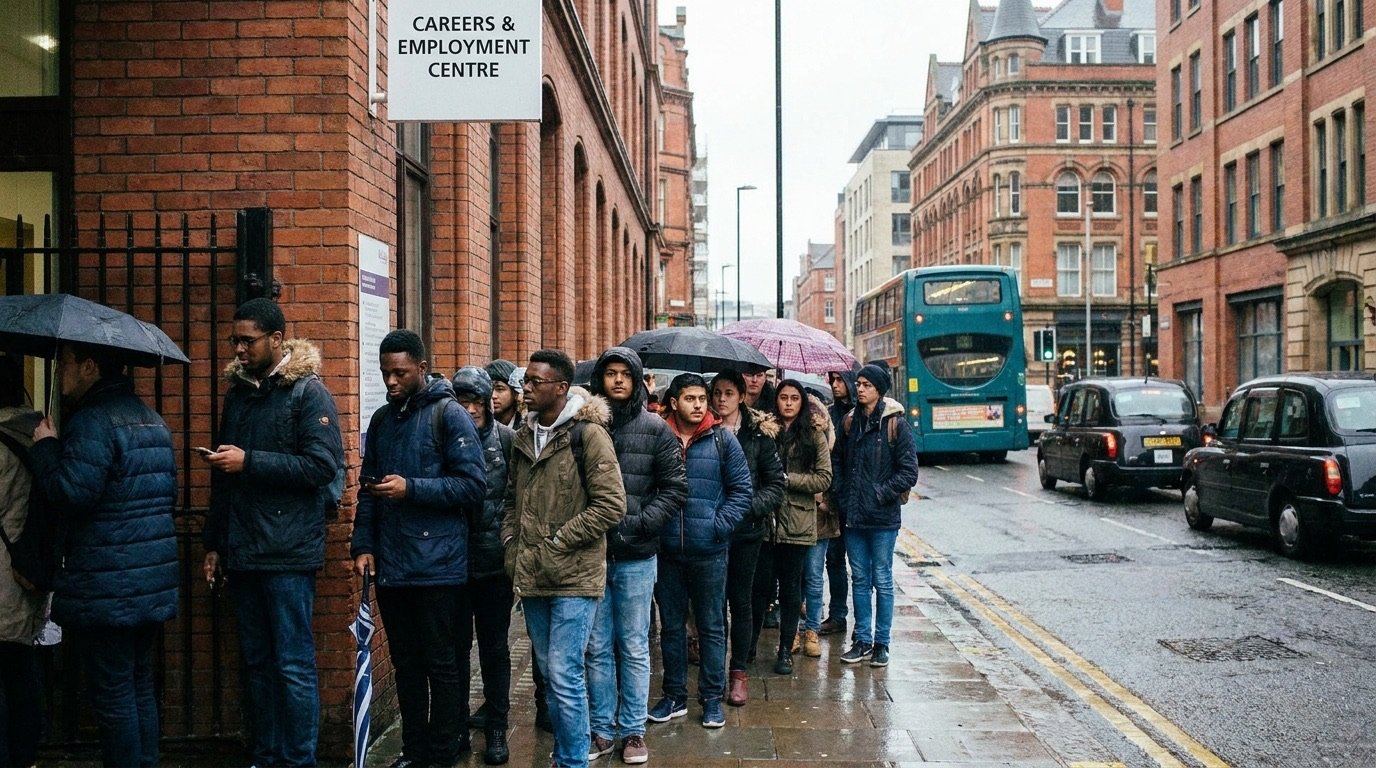
Britain's labour market, long the resilient bright spot of an otherwise sluggish economy, is showing unmistakable signs of strain. The latest figures from the Office for National Statistics show the headline unemployment rate has risen to 5.0%, with around 1.81 million people aged 16 and over now out of work. The number of unemployed people has jumped by 192,000 over the past year, pushing the jobless rate up from 4.5%.
The most alarming detail lies in the data on young people. Youth unemployment has climbed to 14.7%, meaning roughly one in seven 16-to-24-year-olds who want a job cannot find one. That is the highest rate since late 2014, and more than one in five young jobseekers have now been out of work for over a year, the kind of long-term joblessness that economists fear can leave lasting scars.
Taken together, the figures paint a picture of an economy quietly shedding jobs even as the headline growth numbers hold up, a pattern that should worry policymakers more than the soothing top-line statistics might suggest.
A market that is cooling from the bottom up
The weakness is not confined to the young. Estimates of payrolled employees fell by 104,000, or 0.3%, over the year to March, and job vacancies have slipped to 705,000 in the February-to-April window, now below their pre-pandemic level. When vacancies fall below where they sat before the COVID disruption, it is a reliable sign that employers have grown cautious about hiring.
Employers blame a combination of weak demand, higher employment costs and uncertainty about the economic outlook. Entry-level roles, apprenticeships and the hospitality and retail jobs that traditionally give young people their first foothold have been among the hardest hit, which helps explain why the youth figures have deteriorated faster than the overall rate.
“When firms get nervous they stop hiring before they start firing, and the people who feel that first are the ones trying to get on the ladder. A youth unemployment rate near fifteen per cent is a flashing warning light.”
— A labour market economist
The regional and human picture
The pain is unevenly spread. London continues to record the highest regional unemployment rate in the UK at 7.3%, a striking statistic for the country's economic engine and a reminder that the capital's high cost of living can coexist with a slack jobs market. The claimant count, a measure of people receiving unemployment-related benefits, rose on the month to around 1.7 million.
Behind the percentages are real consequences. Long spells of youth unemployment are associated with lower lifetime earnings, weaker mental health and a higher chance of repeated joblessness later in life, a phenomenon economists call scarring. The longer the current softness persists, the greater the risk that today's struggling school and university leavers carry the cost for years.
- Headline unemployment has risen to 5.0%, up from 4.5% a year earlier.
- Around 1.81 million people aged 16 and over are now unemployed, an increase of 192,000 over the year.
- Youth unemployment stands at 14.7%, the highest since late 2014.
- More than one in five young jobseekers have been out of work for over a year.
- Payrolled employment fell by 104,000 over the year to March, and vacancies dropped to 705,000.
- London has the highest regional unemployment rate at 7.3%.
Background
For most of the post-pandemic period the UK labour market defied expectations, with unemployment hovering near historic lows even as growth stagnated. That resilience gave the Bank of England and the Treasury some comfort that the economy could withstand higher interest rates. The recent turn marks a clear break from that pattern and suggests the lagged effects of tighter monetary policy, weaker confidence and rising business costs are finally biting.
Measuring the labour market has itself become harder in recent years, as falling survey response rates have forced the ONS to lean more heavily on tax and benefits data. That has prompted some economists to treat the precise figures with caution, while still accepting the broad direction of travel, which is unambiguously towards a weaker market.
What it means
A softening jobs market complicates the picture for rate-setters, who must weigh rising inflation against an economy that is plainly losing momentum. For the government, the youth figures in particular create political pressure to act, whether through targeted support, training schemes or incentives for employers to hire young workers. For the rest of us, the message is that the labour market's long run of strength has ended, and that the cost of the slowdown is falling first and hardest on those at the very start of their working lives.
Referenced coverage: Our reporting and analysis draws on coverage first reported by FE News. The NE Times publishes original reporting and independent analysis written by our editorial team. We credit and link the outlets whose primary reporting informed this article.
The NE Times is an independent news and analysis publisher. Our articles combine factual reporting with clearly-written, impartial analysis. Content is for general information and does not constitute professional advice. Disclaimer.
You may also like to read

Youth unemployment hits decade high as UK job vacancies dry up
One in seven young people are now looking for work, with the youth jobless rate climbing to 14.7 per cent and vacancies falling to their lowest level since 2021.
Unemployment climbs to 5% as UK labour market shows deepening strain
Payroll numbers are falling and youth unemployment has hit its highest level in over a decade, while pay growth barely keeps pace with inflation, painting a picture of a jobs market under pressure.

Permanent hiring slides again as firms hold back on recruitment
The closely watched Report on Jobs shows employers leaning on temporary staff while delaying permanent appointments amid an uncertain economic backdrop.

Quiz shutters its last 37 shops as Britain's high street reckoning deepens
The Scottish fashion chain is closing its remaining stores by the end of June after a second collapse into administration in under a year, with around 500 jobs lost and other names following it off the high street.