Footsie's record-breaking run: how London became 2026's reluctant bull market
The FTSE 100 smashed through 10,000 points for the first time in January and has spent the year setting fresh records, yet many ordinary investors and pension savers are only dimly aware that British shares are having their best run in a generation.
Rajan Mehta
Writer ·
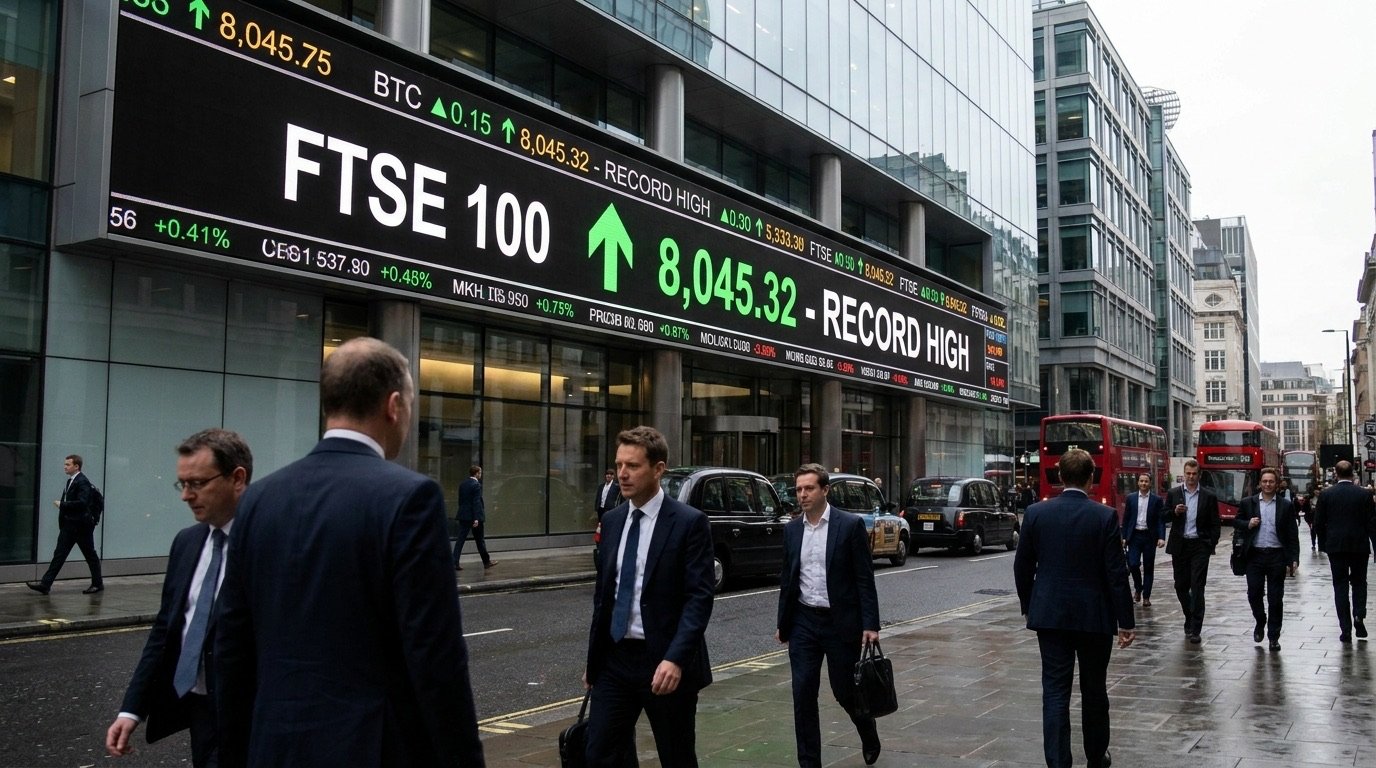
For years the FTSE 100 was the wallflower of the world's major stock markets, watching from the sidelines while Wall Street's technology giants and Europe's luxury houses powered ahead. That story has been quietly rewritten in 2026. London's blue-chip index began the year by crashing through the symbolic 10,000-point barrier for the first time in its history, and it has spent the subsequent months grinding out a succession of record highs that few City forecasters had pencilled in.
The index touched an intraday peak above 10,750 in late February and, despite a volatile spring dominated by an oil-price shock, was trading around the 10,460 mark by the middle of June. The gains build on a remarkable 2025, when the Footsie rose by roughly a fifth in its best annual performance since the post-financial-crisis rebound of 2009.
Yet the rally has an oddly muted feel. There has been none of the euphoria that accompanies a classic bull market, in part because the companies doing the heavy lifting are unglamorous miners, banks, oil majors and defensive consumer names rather than household technology brands. This is general market information rather than financial advice, but understanding why London is suddenly back in favour matters for anyone with a workplace pension.
What is actually driving the gains
Several forces have combined to push the index higher. The first is valuation: UK shares spent much of the past decade trading at a steep discount to their American and European peers, and a growing number of overseas buyers and private-equity firms have decided that discount is no longer justified. As those bidders circle, share prices have re-rated upwards.
The second is the composition of the index itself. The FTSE 100 is dominated by global businesses that earn the bulk of their revenues abroad, so a softer pound flatters their sterling-denominated profits. Energy majors have also benefited from firmer oil prices, while the big banks have enjoyed a longer-than-expected period of elevated interest rates.
The third factor is a wave of corporate activity. Takeover bids, share buy-backs and special dividends have all returned cash to investors and signalled that boardrooms believe their own shares are cheap.
- Heavyweight miners and energy producers, whose earnings are tied to global commodity prices, have powered much of the advance.
- Banks have benefited from a base rate that has stayed higher for longer than markets once expected.
- A flurry of takeover approaches for undervalued London-listed firms has lifted the wider mid-cap market too.
- Large companies including Shell have run multibillion-dollar buy-back programmes, shrinking the share count and supporting prices.
- A weaker pound has boosted the sterling value of overseas earnings for the index's many multinationals.
“The discount on UK equities became so wide that it stopped being a value trap and started being a genuine opportunity. International buyers noticed before domestic investors did.”
— An equity strategist at a London investment house
The crowd that isn't celebrating
If London shares are booming, the average British saver could be forgiven for not feeling it. Domestic retail investors have spent years steadily pulling money out of UK-focused funds, and many workplace pension schemes now allocate only a modest slice of their members' money to home-market equities. The irony is that a record-breaking year for the FTSE may be benefiting overseas funds and sovereign wealth investors more than the British public.
There is also a structural worry lurking beneath the headline numbers. Even as prices rise, the London market continues to shrink as companies are bought out, choose to list in New York instead, or move their primary listing abroad altogether. A rising index masks a falling number of listed businesses, which is precisely the wrong direction for a financial centre hoping to attract the next generation of growth companies.
Background
The FTSE 100 was launched in 1984 with a base value of 1,000 points and tracks the hundred largest companies listed in London by market value. For much of the 2010s it traded in a narrow range, repeatedly failing to push convincingly past its previous peaks while US indices set record after record. The breakthrough above 10,000 in January 2026 therefore carried genuine psychological weight, even if the milestone is partly a quirk of how indices compound over decades.
The advance has not been a straight line. A conflict in the Middle East sent oil prices sharply higher in the spring, briefly rattling equities and lifting inflation expectations, before the index regained its footing. That episode underlined how sensitive the energy-heavy FTSE remains to geopolitical events well beyond Britain's borders.
What happens next
Attention in the City has already turned to whether the index can mount a sustained assault on 11,000, a level most analysts think will prove harder to reach and hold given the lingering uncertainty over interest rates and energy costs. Much will depend on whether the takeover boom continues to flatter valuations and whether domestic investors finally start to follow the overseas money back into UK shares. For pension savers, the more important point is simpler: after years in the shadows, London's stock market is once again worth paying attention to.
Referenced coverage: Our reporting and analysis draws on coverage first reported by Morningstar UK. The NE Times publishes original reporting and independent analysis written by our editorial team. We credit and link the outlets whose primary reporting informed this article.
The NE Times is an independent news and analysis publisher. Our articles combine factual reporting with clearly-written, impartial analysis. Content is for general information and does not constitute professional advice. Disclaimer.
You may also like to read
Schroders falls to £9.9bn US bid as foreign buyers feast on cheap British firms
The agreed takeover of one of the City's grandest names by America's Nuveen has become the defining symbol of a 2026 bid frenzy, as overseas predators and private equity hunt out the UK's persistently undervalued listed companies.
FTSE 100 holds firm as Wall Street tech sell-off rattles global markets
London's blue-chip index closed marginally higher at the start of June, shrugging off a sharp slide on US technology shares thanks to strength in banks and miners.

Muted markets, mixed verdicts abroad as Starmer's exit confirmed
Sterling and gilts barely flinched after a change long anticipated by investors, while European leaders offered warm farewells, Donald Trump was dismissive and Moscow claimed credit.

Markets shrug, then watch: pound steady and gilts ease as investors look past Starmer's exit
Sterling and government bonds moved only modestly on news of the resignation, with investors focused less on the departing prime minister than on whether his successor sticks to the fiscal rules.